AI agents have transformed how businesses handle complex tasks. They excel at writing code, crafting professional communications, and analyzing vast amounts of data with remarkable precision.
According to recent market research, the global AI agents market was valued at approximately $5.4 billion in 2024 and is expected to grow at a rapid pace, with a projected compound annual growth rate (CAGR) of 45.8% between 2025 and 2030.
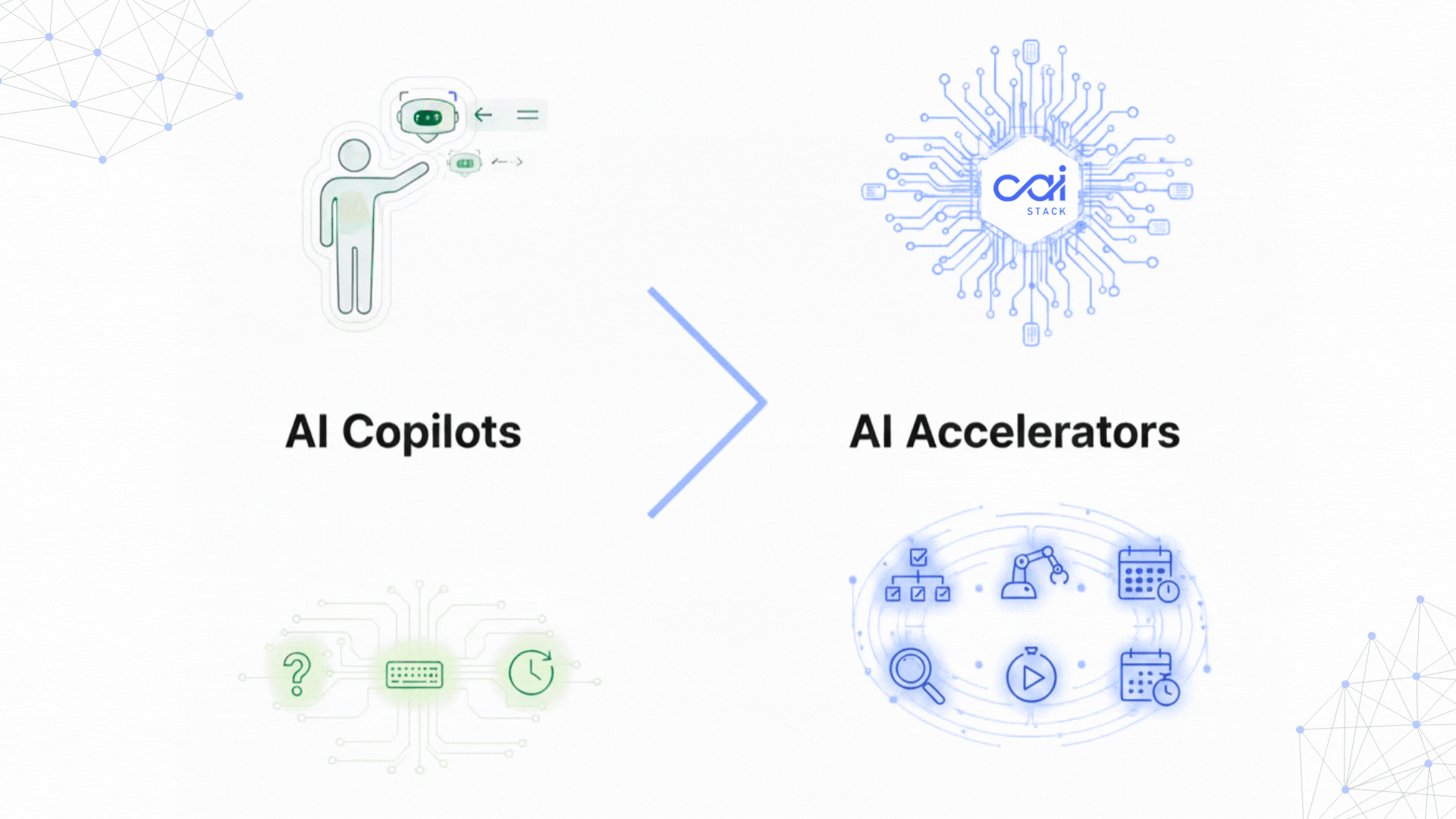
The next evolution takes them beyond analysis into action. Modern businesses need AI agents that can seamlessly connect with existing tools and systems to execute complete workflows.
Model Context Protocol enables this transformation, turning intelligent analysis into intelligent action. Let’s discuss this transformation further in this blog.
AI agents are intelligent systems that understand tasks, make decisions, and execute actions autonomously. Unlike basic chatbots, they handle multi-step processes,
These autonomous systems operate independently, adapting strategies while pursuing defined business objectives.
Companies build autonomous AI agents that sound impressive in demos. They showcase agents that can analyze quarterly reports, draft strategic documents, and answer customer questions with remarkable accuracy.
But when it comes to actually executing tasks, these agents hit a brick wall.
LLM-based AI agents can process information brilliantly. They understand context, reason through problems, and generate human-quality responses. Yet they can't send that email they just drafted. They can't save the report they analyzed. They can't check if inventory levels match their recommendations.
That's because traditional AI agent architecture treats external connections as afterthoughts. Each tool integration requires custom code, unique API handling, and separate security implementations.
Tired of AI agents that can think but can't act? CAI Stack can change that.
Model Context Protocol (MCP) was introduced in November 2024 as an open standard to connect AI systems for streamlining data sharing & execution, including content repositories, business tools, and development environments
Model Context Protocol that creates a unified way for AI systems to connect with external tools and data sources.
Think of MCP as the universal adapter for AI systems.
Before MCP, connecting an AI agent to external tools felt like trying to plug a USB device into every different port imaginable. Each connection needed its adapter, its own setup process, and its own troubleshooting.
MCP creates a single, standardized way for AI agents to connect with any tool, database, or service. One protocol. One connection method. Unlimited possibilities.
As of May 2025, there are over 5,000 active MCP servers, indicating rapid adoption and integration across various platforms.
Before MCP, connecting AI agents to external tools was like trying to plug different devices into incompatible ports - each requiring its own adapter and setup. MCP creates the universal adapter that makes all connections work the same way.
Result: Build once, integrate many - instead of building custom connections for each tool.
MCP operates on a simple client-server model that works in the real world.
This architecture means your autonomous AI agents can discover new tools dynamically, understand their capabilities automatically, and start using them immediately.
Companies implementing MCP report drastic changes in AI agent effectiveness.
Block uses MCP to connect internal knowledge systems with AI agents, enabling instant access to company-specific data and processes.
Replit integrated MCP so their coding agents can read files, write code, and execute commands across entire project environments.
Microsoft has integrated MCP into Windows 11, enabling AI agents to interact seamlessly with applications and system tools, laying the foundation for an AI-first future.
Ready to see what MCP can do for your business? Book a free demo with CAI Stack.
Traditional AI context memory approaches store static information that quickly becomes outdated.
MCP flips this model. Instead of storing context, it provides real-time access to fresh information whenever agents need it.
When your sales agent needs customer history, MCP connects to your CRM instantly. When your finance agent requires current market data, MCP pulls live feeds. When your support agent needs product information, MCP accesses updated documentation.
This approach eliminates stale data problems while ensuring agents always work with current information.
Enterprise AI agent architecture demands security without sacrificing functionality.
MCP handles this through modular security implementations. Developers can add OAuth authentication, implement TLS encryption, and create custom authorization rules without rebuilding the entire connection framework.
Companies like Cloudflare provide OAuth libraries specifically designed for MCP implementations, making enterprise-grade security accessible to development teams.
Concerned about AI agent security? CAI Stack implements MCP with enterprise-grade protection.
Single AI agents solve specific problems. Autonomous AI agents working together solve business challenges.
MCP enables true multi-agent coordination by providing shared access to the same tools and data sources. When your marketing agent identifies a trending topic, your content agent can immediately create relevant materials. When your sales agent closes a deal, your fulfillment agent can start processing orders.
This coordination happens because all agents use the same MCP connections to access the same real-time information.
The MCP ecosystem is exploding with practical solutions.
This ecosystem means LLM-based AI agents can connect to hundreds of tools without custom development work.
Anthropic has released approximately 320 prebuilt MCP connectors on their official GitHub, enabling developers to integrate with popular tools out of the box.
The open-source community is accelerating this growth with over 4,774 MCP servers contributed on MCP.so and more than 3,300 on Glama.ai. This robust library of connectors drastically reduces the time and effort required to build powerful multi-tool integrations.
Organizations mastering AI context memory through MCP are building sustainable competitive advantages.
Major AI providers, including OpenAI and Google DeepMind, have adopted MCP, highlighting its potential as a universal standard for AI system connectivity.
Traditional AI agent architecture creates smart assistants. MCP creates digital employees.
The difference determines whether your AI initiatives deliver measurable business value or remain interesting experiments.
Ready to deploy AI agents that get things done? Contact CAI Stack and let's build your MCP-powered AI workforce.
Subscribe to get the latest updates and trends in AI, automation, and intelligent solutions — directly in your inbox.
Explore our latest blogs for insightful and latest AI trends, industry insights and expert opinions.
Empower your AI journey with our expert consultants, tailored strategies, and innovative solutions.